
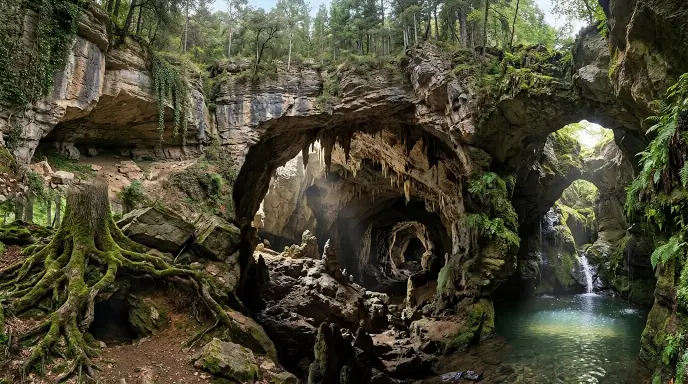
A cave is a natural hollow or chamber in the ground, usually large enough for a person to enter. The word can also be used figuratively, as in “cave in,” meaning to give up or stop resisting. Because the best replacement depends on the context, words such as cavern, grotto, chamber, hollow, and den are not always interchangeable.
People search for synonyms for cave for many reasons: to improve descriptive writing, avoid repetition, choose a more formal word, describe a specific geological feature, or find a better term for fiction, travel writing, academic work, or everyday conversation. The sections below explain which alternatives are closest in meaning and where each one works best.
Quick Answer
The closest synonyms for cave include cavern, grotto, hollow, cavernous chamber, underground chamber, den, burrow, and cavity. However, they are not all exact synonyms. Cavern usually suggests a large cave, grotto often describes a small or attractive cave, and den or burrow refers to an animal’s shelter.
Quick List of Synonyms for Cave
Closest Alternatives
- Cavern
- Grotto
- Hollow
- Underground chamber
- Underground passage
- Natural chamber
- Cavity
- Subterranean chamber
Contextual Alternatives
- Den
- Burrow
- Hideout
- Shelter
- Tunnel
- Passage
- Crevice
- Rock shelter
Descriptive or Literary Alternatives
- Cavernous chamber
- Rocky hollow
- Underground retreat
- Subterranean hollow
- Stone chamber
- Hidden grotto
- Rocky chamber
Not every term above means exactly the same thing. A cavern, for example, is generally a large cave, while a burrow is an animal’s tunnel or hole. The right choice depends on what kind of cave you are describing.
Formal Alternatives for Cave
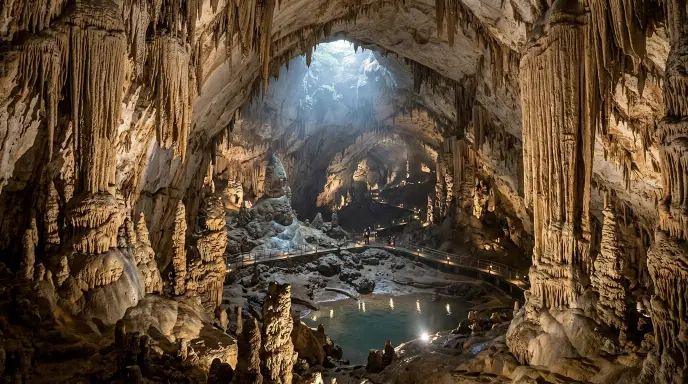
Formal vocabulary is especially useful in academic, scientific, technical, and descriptive writing. Some formal alternatives are exact enough to replace cave, while others describe a particular type of underground feature.
Cavern
Meaning: A large natural underground space.
Explanation: Cavern is one of the closest alternatives to cave. It usually suggests something larger, deeper, or more impressive.
Example: The researchers entered a vast cavern beneath the limestone ridge.
Best Use: Descriptive, scientific, travel, and literary writing.
Worst Use: Avoid it when describing a very small opening or shallow hollow.
Tone: Formal, descriptive, and sometimes dramatic.
Underground Chamber
Meaning: An enclosed space beneath the surface.
Explanation: This phrase emphasizes the chamber-like structure rather than the natural formation itself. It can describe a cave but does not necessarily imply that the space is naturally formed.
Example: Archaeologists discovered an underground chamber beneath the ancient settlement.
Best Use: Academic, archaeological, historical, and technical writing.
Worst Use: Avoid it if you specifically need to identify a geological cave.
Tone: Formal and precise.
Subterranean Chamber
Meaning: A chamber located underground.
Explanation: Subterranean means beneath the earth’s surface. The phrase sounds more technical than underground chamber.
Example: The survey revealed a previously unknown subterranean chamber.
Best Use: Academic and technical writing.
Worst Use: It may sound unnecessarily formal in everyday conversation.
Tone: Highly formal and technical.
Natural Chamber
Meaning: A naturally formed enclosed space.
Explanation: This term focuses on the formation of the space. It can refer to a room-like part of a cave.
Example: The expedition mapped each natural chamber inside the formation.
Best Use: Geological and scientific descriptions.
Worst Use: It can sound vague if the reader needs to know that the formation is specifically a cave.
Tone: Neutral to formal.
Subterranean Hollow
Meaning: A hollow space located below ground.
Explanation: This is a descriptive alternative rather than a perfect synonym. Hollow can refer to a depression or empty space and does not always mean a cave.
Example: The trail led toward a dark subterranean hollow.
Best Use: Literary and descriptive writing.
Worst Use: Avoid it in technical writing when geological precision matters.
Tone: Formal and literary.
Underground Passage
Meaning: A route or opening that runs beneath the ground.
Explanation: An underground passage may be part of a cave system, but it is not necessarily a complete cave.
Example: The explorers followed an underground passage toward the river.
Best Use: Describing movement through a cave system.
Worst Use: Do not use it if you mean a large open cavern rather than a route.
Tone: Neutral and descriptive.
Rock Shelter
Meaning: A naturally protected space beneath or beside rock.
Explanation: A rock shelter is related to a cave but is usually more open on one side. It is an important distinction in archaeology.
Example: Archaeologists found ancient tools inside the rock shelter.
Best Use: Archaeological and historical writing.
Worst Use: It is inaccurate when describing a fully enclosed cave.
Tone: Technical and precise.
Cavity
Meaning: An empty space within a solid structure or material.
Explanation: Cavity is broader than cave. A cave can be a natural cavity in rock, but not every cavity is large enough to enter.
Example: Water had created a cavity inside the limestone.
Best Use: Scientific and geological writing.
Worst Use: Avoid it when you want a vivid description of an explorable cave.
Tone: Technical and neutral.
Cavernous Space
Meaning: A large, open space resembling a cavern.
Explanation: This phrase is descriptive rather than a direct noun replacement. It emphasizes size and openness.
Example: The abandoned mine opened into a cavernous space.
Best Use: Architecture, fiction, travel writing, and descriptive prose.
Worst Use: It may be too vague for scientific identification.
Tone: Formal and descriptive.
Subterranean Hollow
Meaning: A hollow or empty area beneath the earth.
Explanation: This phrase can describe a cave-like environment without directly calling it a cave. However, it does not establish the same geological meaning.
Example: The explorers reached a vast subterranean hollow.
Best Use: Creative and descriptive writing.
Worst Use: Avoid it when precision is more important than atmosphere.
Tone: Literary and formal.
Semi-Formal and Neutral Alternatives
Hollow
Meaning: An empty or sunken space.
Explanation: Hollow can describe a cave-like opening, but it is much broader. It may also describe a low area between hills.
Example: They discovered a dark hollow beneath the rocks.
Best Use: General and descriptive writing.
Worst Use: Technical geological writing where cave is more precise.
Tone: Neutral and natural.
Grotto
Meaning: A small cave or attractive natural chamber, often associated with water or gardens.
Explanation: Grotto is related to cave but carries a more picturesque feeling.
Example: A narrow path led to a peaceful grotto beside the lake.
Best Use: Travel writing, literature, landscaping, and descriptions of scenic caves.
Worst Use: Avoid it for a huge, dangerous cave system.
Tone: Elegant, picturesque, and sometimes romantic.
Den
Meaning: A sheltered place used by a wild animal.
Explanation: A den can be inside a cave, but den focuses on the animal’s use of the space rather than its geological structure.
Example: The fox disappeared into its den.
Best Use: Animal behavior and nature writing.
Worst Use: Do not use den simply to mean any cave.
Tone: Neutral and natural.
Burrow
Meaning: A hole or tunnel dug by an animal.
Explanation: A burrow is not normally a natural cave. It is generally associated with animals digging into soil, earth, or soft material.
Example: The rabbit quickly escaped into its burrow.
Best Use: Animal-related contexts.
Worst Use: Geological descriptions of natural caves.
Tone: Neutral and everyday.
Shelter
Meaning: A place that provides protection from weather or danger.
Explanation: A cave can provide shelter, but shelter describes its function rather than its physical form.
Example: The hikers used the rocky shelter to escape the storm.
Best Use: Survival, hiking, camping, and historical contexts.
Worst Use: When you need to identify a specific geological formation.
Tone: Neutral.
Tunnel
Meaning: A passage through or under something.
Explanation: A cave may contain tunnels, but a tunnel is not necessarily a cave. Human-made tunnels are especially different.
Example: The explorers crawled through a narrow tunnel.
Best Use: Describing a passage within an underground system.
Worst Use: Do not call a man-made tunnel a cave.
Tone: Neutral.
Passage
Meaning: A route or corridor through a place.
Explanation: Passage is useful for describing a narrow section inside a cave.
Example: The narrow passage eventually opened into a large chamber.
Best Use: Cave exploration and descriptive writing.
Worst Use: It cannot always replace cave because it describes movement or a route rather than the entire formation.
Tone: Neutral and descriptive.
Crevice
Meaning: A narrow crack or opening in rock.
Explanation: A crevice can lead into a cave, but it is generally much narrower.
Example: The lizard disappeared into a crevice in the cliff.
Best Use: Describing narrow rock openings.
Worst Use: Avoid it for a large underground chamber.
Tone: Neutral and precise.
Hideout
Meaning: A concealed place where someone or something hides.
Explanation: A cave may serve as a hideout, but the word describes its purpose rather than its physical structure.
Example: The smugglers used the remote cave as a hideout.
Best Use: Fiction, crime stories, and historical narratives.
Worst Use: Scientific or geological writing.
Tone: Informal and narrative.
Informal and Casual Alternatives
English has relatively few true casual synonyms for cave. Most casual alternatives describe a cave’s function or appearance rather than replacing the word exactly.
Hideaway
A hideaway is a secluded place where someone can retreat or hide.
Example: They found a quiet hideaway beneath the cliffs.
It sounds natural in casual conversation and creative writing, but it does not specifically mean a geological cave.
Hideout
A hideout is a concealed location used for hiding.
Example: The characters discovered a secret hideout inside the cave.
It works well in storytelling but is not a synonym for the geological feature itself.
Hole
Hole is a very broad everyday term for an opening or empty space.
Example: The children found a small hole in the hillside.
It is casual and easy to understand, but calling a large cave a hole can sound imprecise or dismissive.
Underground Place
This phrase can describe a cave informally.
Example: They found an underground place where they could rest.
It is understandable but usually weaker than cave or cavern.
True Synonyms vs. Contextual Alternatives
Understanding this distinction prevents inaccurate word choices.
| Type | What It Means | Can It Replace the Original? |
|---|---|---|
| True synonym | A word with essentially the same core meaning | Usually |
| Near synonym | A word with a closely related meaning but a difference in size, use, or tone | Sometimes |
| Contextual alternative | A word that works in a particular situation | Only in that context |
| Broader expression | A term covering a wider range of things | Sometimes, but meaning becomes less precise |
| Narrower expression | A term describing a specific type or part of a cave | Only when that specific meaning is intended |
For example, cavern is a close synonym, while den is a contextual alternative. A den tells the reader that an animal uses the space. Burrow goes further by suggesting that an animal dug the passage.
Industry-Specific Usage
Business Writing
The word cave is uncommon in ordinary business writing unless the subject involves real estate, tourism, mining, construction, geology, or environmental work.
For reports, use precise terms such as:
- Cave
- Cavern
- Underground chamber
- Subterranean chamber
- Underground passage
Example:
“The survey identified an underground chamber beneath the proposed development area.”
That is more precise than calling every underground feature a cavern.
Corporate Communication
Corporate documents should favor accuracy over dramatic wording.
For example:
“The inspection identified a natural cavity beneath the site.”
is more appropriate for a technical report than:
“The inspection discovered a mysterious cavern.”
The second sentence may be suitable for promotional copy, but it introduces a dramatic tone.
Academic Writing
Academic writing should distinguish between a cave, cavern, cavity, rock shelter, passage, and chamber.
Example:
“Archaeological material was recovered from a rock shelter near the cave entrance.”
Here, rock shelter is more accurate than simply using cave if the space is open on one side.
Customer Service
Customer-facing writing should normally use simple terms.
Example:
“Please follow the marked path to the cave entrance.”
A phrase such as subterranean chamber would usually make the message harder to understand without adding value.
Legal Writing
Legal and regulatory documents require particular care. A cave, cavern, underground passage, and rock shelter may have different physical meanings, and a contract or property document may define a term specifically.
Use the exact terminology required by the relevant document, regulation, survey, or professional report. Do not replace a defined term with a casual synonym simply to make the writing sound varied.
Email Communication

Professional emails usually benefit from cave, cavern, underground chamber, or another precise term rather than a creative synonym.
For example:
“The inspection team identified a natural cavity beneath the eastern section of the property.”
This is clearer and more professional than saying:
“The inspection team found a hidden hole.”
Email Examples
Client Communication
Subject: Site Inspection UpdateWriting
Site Inspection Update
Hello Sarah,
During yesterday’s inspection, our team identified an underground chamber beneath the northern section of the property.
We are reviewing the survey results and will include the finding in the updated site report.
Best,
James
Project Update
Subject: Exploration ProgressWriting
Exploration Progress
Hi Mark,
The team has completed the initial survey of the main cavern and has started mapping the smaller passages connected to it.
We expect to finish the first stage of the survey by Friday.
Regards,
Daniel
Customer Service
Subject: Your Cave TourWriting
Your Cave Tour
Hello,
Your tour will begin at the main cave entrance at 10:00 a.m. Please arrive 15 minutes early so the group can leave on time.
Comfortable shoes are recommended because some sections of the passage are uneven.
Kind regards,
Customer Services
Academic Communication
Subject: Archaeological Site VisitWriting
Archaeological Site Visit
Dear Professor Ahmed,
I have reviewed the notes from the site visit and will refer to the rock shelter separately from the main cave in my assignment.
This distinction should make the archaeological description more precise.
Best regards,
Hassan
Vendor Communication
Subject: Survey Information RequiredWriting
Survey Information Required
Hello Mr. Lee,
Could you please provide the latest geological survey showing the location and dimensions of the underground chamber?
We need the information before completing the site assessment.
Thank you,
Maria
Short Dialogue Examples
Workplace
Person A: Did the survey confirm that there is a cave beneath the site?
Person B: Yes, although the report calls it a natural underground chamber because of its structure.
Classroom
Person A: Is “cavern” exactly the same as “cave”?
Person B: Not quite. A cavern usually suggests a larger cave.
Customer Service
Person A: Where does the tour start?
Person B: At the main cave entrance. Please wait beside the information desk.
Casual Conversation
Person A: What did you find behind the rocks?
Person B: Just a small hollow. It wasn’t really big enough to call a cave.
Professional Discussion
Person A: Should we describe this as a tunnel?
Person B: Only if we’re referring to the passage itself. The larger formation is a cave system.
How to Replace “Cave” in a Sentence
Example 1
Original:
The explorers entered a large cave.
Alternative:
The explorers entered a vast cavern.
Why it works:
Cavern emphasizes the size of the underground space.
Example 2
Original:
The tourists visited a beautiful cave.
Alternative:
The tourists visited a picturesque grotto.
Why it works:
Grotto adds a scenic and attractive quality.
Example 3
Original:
The fox lives in a cave.
Alternative:
The fox lives in a den.
Why it works:
Den is more accurate because the focus is the animal’s shelter.
Example 4
Original:
The researchers discovered a cave beneath the hill.
Alternative:
The researchers discovered an underground chamber beneath the hill.
Why it works:
The alternative sounds more technical, although it does not necessarily identify the feature as a complete cave.
Example 5
Original:
The rabbit disappeared into a cave.
Alternative:
The rabbit disappeared into its burrow.
Why it works:
Burrow identifies an animal-dug shelter rather than a naturally formed cave.
Example 6
Original:
The hikers took shelter in a cave.
Alternative:
The hikers took shelter beneath a rock overhang.
Why it works:
If the hikers were protected by an open rock formation rather than an enclosed cave, rock overhang is more precise.
Example 7
Original:
They walked through the cave.
Alternative:
They walked through the underground passage.
Why it works:
The alternative focuses on the route they followed rather than the entire cave.
Example 8
Original:
Water had formed a small cave in the rock.
Alternative:
Water had formed a cavity in the rock.
Why it works:
Cavity works when the space is relatively small and the geological structure is the focus.
Comparison Table
| Phrase | Tone | Meaning / Scope | Best Use | Example |
|---|---|---|---|---|
| Cave | Neutral | Natural underground space | General writing | We entered the cave. |
| Cavern | Formal/descriptive | Usually a large cave | Travel, literature, geology | The cavern was enormous. |
| Grotto | Literary/scenic | Usually a small or attractive cave | Travel and descriptive writing | They visited a coastal grotto. |
| Hollow | Neutral/literary | Empty or depressed space | General description | A dark hollow lay beneath the cliff. |
| Chamber | Formal | Enclosed room-like space | Technical writing | The cave contained a large chamber. |
| Cavity | Technical | Empty space in a solid material | Science and geology | Water created a cavity in the rock. |
| Den | Neutral | Animal’s shelter | Nature writing | The bear returned to its den. |
| Burrow | Neutral | Animal-dug hole or tunnel | Animal contexts | The rabbit entered its burrow. |
| Tunnel | Neutral | Underground passage | Routes and passages | They entered the tunnel. |
| Rock shelter | Technical | Protected space beneath rock | Archaeology | Tools were found in the rock shelter. |
| Crevice | Neutral | Narrow crack or opening | Rock formations | The snake entered a crevice. |
| Hideout | Casual | Concealed place | Fiction and narrative | The cave served as a hideout. |
Which Alternative Should You Choose?
For Formal Writing
Choose cavern, underground chamber, subterranean chamber, or natural chamber, depending on the intended meaning.
For Business Communication
Use cave, underground chamber, or natural cavity. Choose the term that accurately describes the feature.
For Academic Writing
Prefer precise terms such as cave, cavern, rock shelter, cavity, or underground chamber. Avoid decorative synonyms unless they are appropriate to the subject.
For Legal Writing
Use the terminology established by the relevant document, survey, agreement, or applicable rules. Precision matters more than stylistic variation.
For Professional Email
Cave is usually the safest choice. If the context is technical, use the more specific term.
For Everyday Conversation
Use cave, hollow, or cavern. Most people will understand cave immediately.
For Casual Messages
Cave is still usually the most natural choice. Hole may work when describing a small opening, but it is less precise.
Grammar and Usage Guide
“Cave” as a Noun
The most common use is as a countable noun.
Examples:
- We found a cave near the trail.
- The area contains several caves.
- They explored the cave for two hours.
Use a cave when referring to one unspecified cave and the cave when the reader already knows which one you mean.
Singular and Plural
The singular is cave.
The plural is caves.
Example:
“The region contains hundreds of caves.”
Common Prepositions
Natural combinations include:
- in a cave
- inside a cave
- into a cave
- out of a cave
- near a cave
- under a cave — less common and usually context-dependent
- at the cave entrance
Examples:
- They slept in the cave.
- The hikers walked into the cave.
- Bats flew out of the cave.
“Cave In” Is Different
The phrasal verb cave in has a different meaning.
It can mean:
- To collapse inward.
- To stop resisting or agree after pressure.
Physical meaning:
“The roof of the tunnel caved in.”
Figurative meaning:
“After several hours of discussion, he finally caved in.”
Do not treat cave in as another way to say cave.
Capitalization
Cave is normally lowercase.
Correct:
“We visited the cave.”
Capitalize it only when it is part of a proper name.
Example:
“Carlsbad Caverns” uses capitalization because it is a proper name.
Common Mistakes to Avoid
1. Treating “Cavern” as Always Identical to “Cave”
A cavern usually suggests a larger underground space. It can be a good replacement, but size and tone may change.
2. Calling Every Cave a “Den”
A den is associated with an animal’s shelter. It does not simply mean cave.
3. Using “Burrow” for a Natural Cave
A burrow generally suggests a hole or tunnel dug by an animal.
4. Using “Grotto” for Every Cave
A grotto usually carries a picturesque or scenic sense and often refers to a relatively small cave or chamber.
5. Using “Tunnel” for the Entire Cave
A tunnel describes a passage. A cave can contain tunnels without being one.
6. Choosing “Hole” in Formal Writing
Hole is understandable but broad and informal. It can make a geological description less precise.
7. Using Technical Words Just to Sound Formal
Terms such as subterranean chamber can make simple writing unnecessarily difficult.
8. Ignoring the Intended Function
If the point is that an animal lives in the space, den may be better than cave. If the point is that someone is hiding there, hideout may be appropriate.
When Not to Use the Original Word “Cave”
There are situations where a more specific term is better.
When You Mean a Large Cave
Use cavern if size is an important part of the description.
When You Mean an Animal’s Home
Use den or burrow, depending on how the shelter was formed and used.
When You Mean a Narrow Opening
Use crevice, crack, or opening if the space is too narrow to be considered a cave.
When You Mean a Cave Passage
Use passage or tunnel when you are describing a route rather than the entire formation.
When You Mean a Scenic Small Cave
Grotto may create a more accurate descriptive impression.
When Technical Precision Matters
Use cave, cavern, cavity, rock shelter, or another geological term according to the actual feature.
When “Cave” Is Actually Better
Do not replace cave merely to avoid repetition. It is short, familiar, and precise in many situations. Clear writing is more valuable than forced vocabulary variety.
Advanced Writer Tips
Tone Control
For a neutral tone, use cave.
More dramatic tone, use cavern.
For a scenic tone, use grotto.
For a technical tone, use cavity, natural chamber, or subterranean chamber when accurate.
Professional Email Etiquette
Professional writing usually benefits from direct language.
Instead of:
“We discovered a mysterious subterranean hollow.”
write:
“The survey identified a natural cavity beneath the site.”
The second version gives the reader clearer information.
Politeness
The word cave itself is not impolite. Politeness matters more when you are discussing people, requests, or actions associated with the cave.
Context Alignment
Ask what you actually need to describe:
- The whole geological formation → cave
- A large cave → cavern
- A scenic cave → grotto
- An animal’s shelter → den
- An animal-dug shelter → burrow
- A narrow route → passage
- A narrow opening → crevice
- A protected archaeological space → rock shelter
Precision
The best synonym is not always the most sophisticated word. Choose the term that gives the reader the most accurate mental picture.
Readability
If cave communicates the idea clearly, keep it. Replacing every repeated noun with a different word can make writing less natural rather than more interesting.
Related Questions
What is another way to say “cave”?
The closest alternatives are cavern, grotto, hollow, underground chamber, and natural chamber. The best choice depends on size, setting, and tone.
What is a professional alternative to “cave”?
For professional or technical writing, cavern, underground chamber, natural cavity, or subterranean chamber may work, but only when the term accurately describes the feature.
What is a formal word for “cave”?
Cavern is the most natural formal or literary alternative. Subterranean chamber is more technical but does not always mean exactly the same thing.
Can “grotto” replace “cave”?
Sometimes. A grotto generally suggests a small, attractive, or picturesque cave or chamber. It is not a universal replacement for cave.
Can “den” replace “cave”?
Only when the focus is an animal’s shelter. A den may be located inside a cave, but the words describe different things.
What is the difference between a cave and a cavern?
A cave is a general term for a natural underground space. A cavern is usually understood as a larger or more impressive cave, although the exact distinction can depend on context.
Is “cave” a formal word?
Yes. Cave is a standard, neutral English word. It is not inherently informal. In many situations, it is actually more appropriate than a more complicated synonym.
FAQs
What is the closest synonym for cave?
Cavern is probably the closest common synonym, especially when referring to a large natural underground space. However, cavern can suggest greater size or grandeur, so cave remains the more general term.
What is a fancy word for cave?
Cavern and grotto can sound more literary or descriptive. Cavern suggests size, while grotto often suggests a small, attractive, or scenic cave.
What is a scientific word for cave?
There is no single scientific replacement that should always be used. Cave, cavern, cavity, chamber, and rock shelter can all be appropriate depending on the geological or archaeological feature being described.
Is “hollow” the same as “cave”?
No. Hollow is broader. It can describe an empty or depressed space, including a cave-like opening, but it does not necessarily indicate an underground chamber.
Is “underground chamber” a synonym for cave?
It can describe part of a cave or a cave-like space, but it is not an exact synonym. An underground chamber can be natural or artificial, whereas a cave normally refers to a natural underground feature.
What is the opposite of a cave?
There is no single direct opposite. Depending on the intended contrast, you might use open space, surface, open area, or exposed area.
Which synonym for cave is best in creative writing?
Cavern, grotto, hollow, and rocky chamber can add atmosphere. Choose according to the scene rather than replacing cave automatically.
Key Takeaways
- Cave is the broad, neutral term for a natural underground space.
- Cavern usually suggests a larger or more dramatic cave.
- Grotto often describes a smaller, scenic, or attractive cave.
- Den, burrow, tunnel, and rock shelter are contextual alternatives, not exact synonyms.
- The most accurate word depends on the feature’s size, function, setting, and intended tone.
Conclusion
The best synonym for cave depends on what you want the reader to understand. Cavern is the strongest close alternative when the space is large or dramatic, while grotto works well for a scenic or picturesque setting. Hollow is broader and more literary, whereas cavity, chamber, and subterranean chamber can suit technical descriptions when their specific meanings are accurate. Words such as den, burrow, tunnel, and rock shelter should be used carefully because they describe a cave’s function, structure, or a particular type of underground space rather than simply replacing cave.
For most everyday and professional situations, cave remains the clearest choice. Good writing is not about using the most complicated synonym; it is about choosing the word that communicates the intended meaning, tone, and level of precision with the least confusion.